

Typhoeus Is Not “Stand There and Mash”: Nature Application Is the Engine
Typhoeus has been getting a lot of discussion lately. Many people first notice how aggressive the enhanced basic-attack animations look and assume that once they pull her, they can just stand on field and deal damage. Only after playing her do they realize the core of this kit is not just a basic-attack string—it is whether Nature application, Hunt Arrows, Revelation, and combos can actually connect.
From player guide discussions, Typhoeus can be treated as a core on-field DPS in the current Nature system. Her battle skill consumes Nature application, so teammates have a very clear job: lay down application first so Typhoeus has the resources to use her battle skill, land enhanced basic attacks, then convert Revelation back into Hunt Arrows so the loop can roll.
That also explains why some people feel her “damage is high but the feel is weird”—in most cases it is not that the stats are lacking, but that the team never built the resource environment she needs. Typhoeus is not a character you evaluate on solo strength alone. She is more like an engine that needs teammates to feed her, then amplifies the output tempo herself. Once the rotation is smooth, the whole sequence feels extremely coherent; if it is not, you end up staring at resource bars...
Universal Team: Perlica + (INT) Jue + Typhoeus + Lino
A relatively stable, easy-to-understand four-person framework right now is:
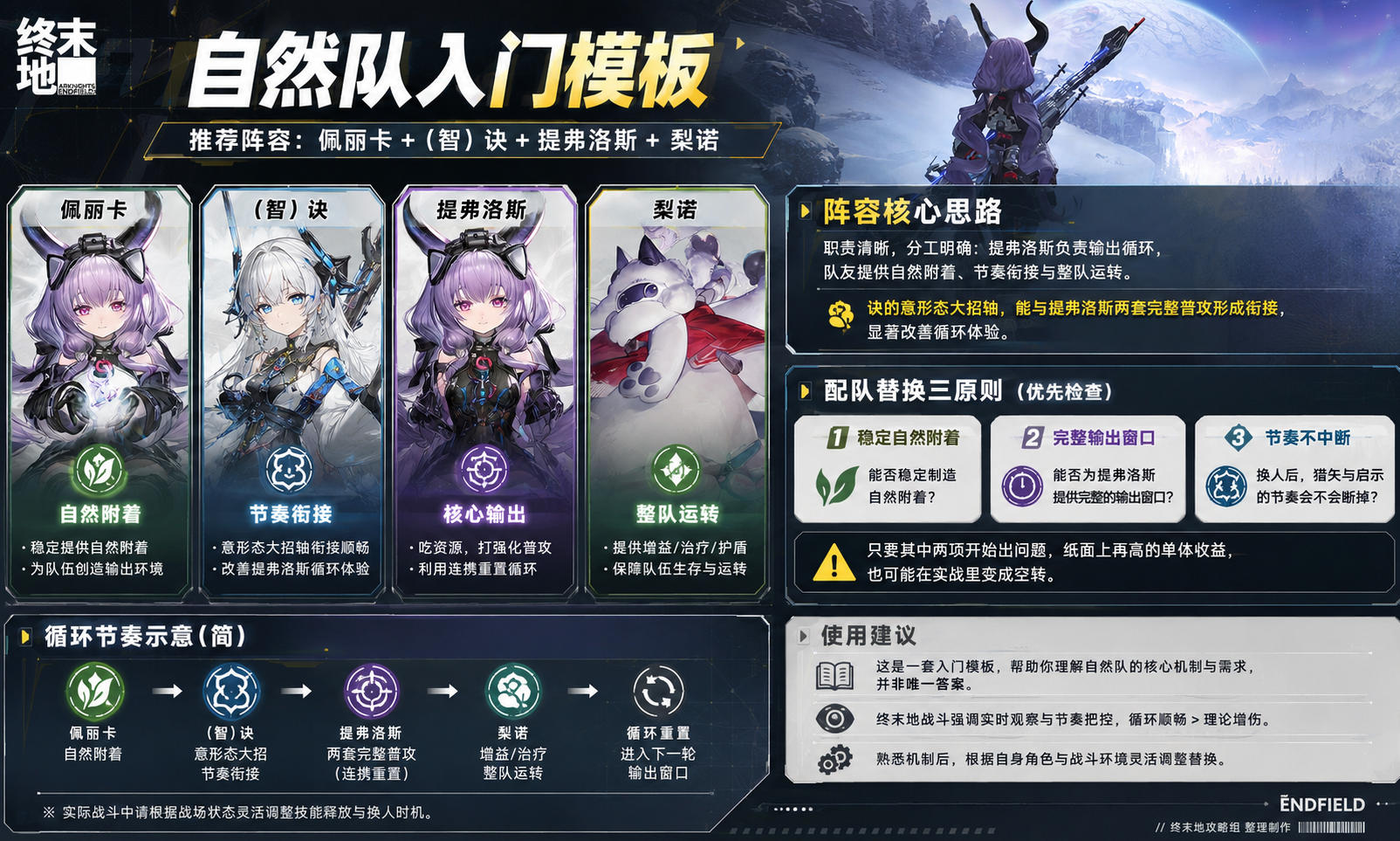
Perlica + (INT) Jue + Typhoeus + Lino.
Do not treat positioning here as rigid. The point is the order of roles: Perlica is there so Nature application can start more smoothly; (INT) Jue holds an important slot that links into Typhoeus’s damage axis; Typhoeus is of course the main burst point on field; Lino keeps the team more stable in prolonged fights so you do not push a damage window so hard that the situation becomes precarious.
Perlica: Apply Nature First
Perlica’s most important value in this lineup is not stealing damage. It is getting Typhoeus into a comfortable resource range sooner. Typhoeus’s battle skill consumes Nature application, so whether the pre-application is stable directly decides whether she can string Hunt Arrows, Revelation, and enhanced basic attacks together.
In actual fights, do not dump every resource the moment Typhoeus can take the field. Confirm that Nature application is sufficient, then let the main DPS come in and spend it—the tempo will feel much smoother. What Nature teams fear most is not playing slowly; it is the main DPS dumping a key battle skill before application is ready. That wave is especially wasteful.
(INT) Jue: Do Not Underestimate the Second-Stage Ultimate’s Link Value
The key to pairing (INT) Jue with Typhoeus is that their ultimate timelines can align fairly naturally. Under a common play pattern, after Typhoeus finishes two full sets of enhanced basic attacks, you can chain into Jue’s second-stage ultimate. That design feels good because it does not ask you to memorize a complicated countdown; the damage sequence itself becomes the trigger for a teammate’s burst.
So in practice, treat Jue as the character who “takes over after Typhoeus finishes a key loop,” not someone who dumps the entire ultimate the moment the fight starts. Releasing it too early is not necessarily wrong, but you lose the value of overlapping team burst. Especially against elites or phased bosses, holding the second-stage ultimate until Typhoeus has finished a full round of enhanced basic attacks usually feels and pays better.
Lino: Give the Damage Loop Room for Error
Lino’s slot is more like a stabilizer. Typhoeus’s play already requires watching resources, tracking airborne windows, and hitting combo nodes. If the team is also under heavy survival pressure, it is easy to interrupt the entire loop just to dodge skills.
So Lino is not merely “filling a fourth slot.” She is the character who pulls the team from a theoretical rotation back into real combat. For new players still learning Typhoeus, stability is often more valuable than greedy max damage. First land the full loop, then compress time and optimize burst windows. That is the more comfortable growth path.
How to Open: Remember “8 Revelation = 4 Hunt Arrows”
In Typhoeus’s resource loop, the first thing worth memorizing is not a long string of inputs, but a simple mnemonic:
8 Revelation = 4 Hunt Arrows.
At the start, Typhoeus herself has 4 Revelation. Then use the battle skill, spend 4 Hunt Arrows to deliver the first four enhanced basic attacks, and gain 4 Revelation, bringing you exactly to 8 Revelation.
Do not rush to smash through the rest of the sequence. The key node is before the fifth enhanced heavy attack, while the target is still airborne: use a combo to convert 8 Revelation into 4 Hunt Arrows and reset enhanced basic attacks. After the conversion, continue into a full set of enhanced basic attacks so resources and damage stay connected.
The real point of this opener is to complete the first self-sustaining resource loop as fast as possible. Many players treat “combo” as just an extra attack you press when a prompt appears. For Typhoeus, combo is more like a resource gearbox: when Revelation is full, convert to Hunt Arrows; Hunt Arrows fuel the battle skill and enhanced basic attacks; then you bank Revelation again. Once you understand that layer, the mechanical difficulty drops a lot.
Charging Axis: Do Not Break Nature Application, and Do Not Combo Too Early
Once you enter the regular charging phase, the flow roughly centers on “stack Nature application—bank Revelation—combo into Hunt Arrows—battle skill spends resources.”
First have the team apply 4 stacks of Nature application; you can gain 3 Revelation at that point. If existing resources bring you to 8 Revelation, combo to convert into 4 Hunt Arrows. Then Typhoeus uses the battle skill, spends 4 Hunt Arrows to complete the first four enhanced basic attacks, gains Revelation along the way, and because Nature application is consumed she also recovers more Revelation, arriving at 8 Revelation again.
Before the fifth enhanced heavy attack, still watch the airborne state. When the timing is right, combo again to convert resources and reset enhanced basic attacks, then finish a full enhanced-basic-attack set. Repeat until ultimate energy is full.
This looks like a lot of text. After you actually play it, there are really only two checks:
First, whether Nature application has been stacked enough; Second, when Revelation hits 8, whether the airborne window is still there.
If application is insufficient, the battle skill’s value shrinks. If you combo too early or too late, the enhanced-basic-attack reset falls apart. When you are first practicing, you do not need every round to look textbook. Prioritize not losing on the core exchange of “8 Revelation into 4 Hunt Arrows,” and the damage tempo will stabilize on its own.
Ultimate Axis: Finish Two Sets, Then Let Jue Take the Second-Stage Ultimate
The axis after Typhoeus ults is even more worth practicing patiently, because this is the stretch where the whole team’s damage feels strongest.
The ultimate consumes 2 Hunt Arrows and delivers a full set of enhanced basic attacks, then grants 3 Revelation, bringing resources to 8 Revelation. Next, use combo to convert 8 Revelation into 4 Hunt Arrows; then start the battle skill, spend 4 Hunt Arrows to deliver another full set of enhanced basic attacks, and gain 5 Revelation.
The core result is that Typhoeus, through two full sets of enhanced basic attacks, compresses her personal burst, resource conversion, and teammates’ burst windows into the same stretch of time. After those two sets, let (INT) Jue chain the second-stage ultimate, and the team’s damage tempo will feel very tight.
An easy mistake here: after ulting, a lot of people get caught up in the busy visuals and mash combo and battle skill back-to-back, so enhanced basic attacks never reset at the right node. Practice the tempo first in low-pressure stages, watching the order “Revelation to 8—combo convert—then battle skill.” Once it is familiar, your hands will be much steadier in high-pressure fights.
Building and Resource Planning: Secure the Loop First, Chase Caps Later
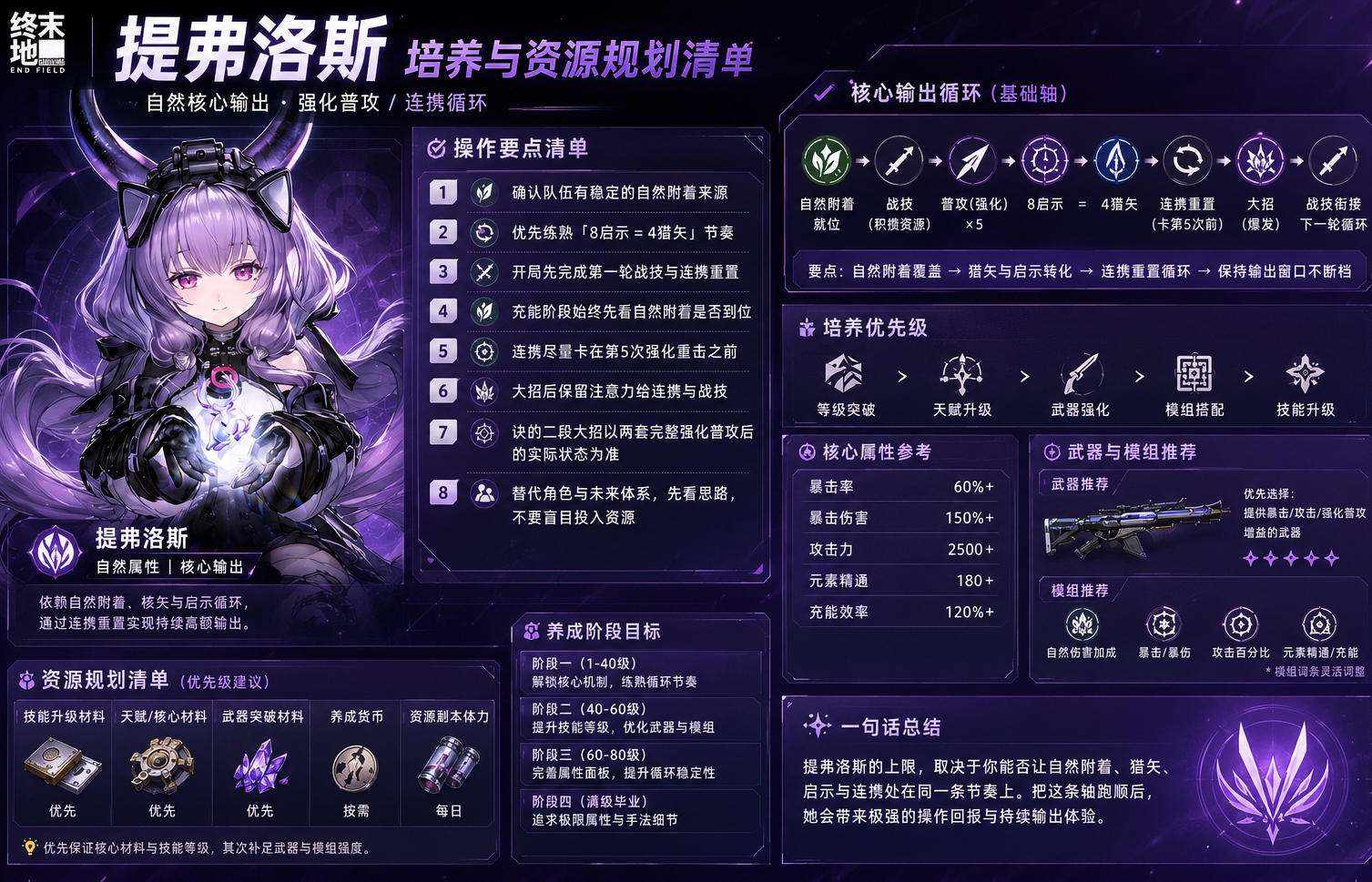
Typhoeus’s building priority should not revolve around a single damage number. Her strength is built on a complete loop, so first make sure core skills and team synergy actually function, then keep pushing the stat sheet. That better matches real play.
When resources are limited, prioritize Typhoeus as the main investment and, in parallel, make sure Perlica and (INT) Jue’s key functions do not fall off. A fully built Typhoeus with no stable Nature application or burst chaining may not feel better in real fights than a balanced, complete four-person team.
As for whether a better vanguard replacement for the Nature system will appear later, player communities certainly have plenty of bold guesses: if a future character can stack Nature application faster and also provide extra combo conditions, Typhoeus’s loop might speed up further. Treat that as a direction to watch for team-building, not as a settled conclusion before anything ships, and there is no need to overspend resources on speculation.
KARDZ Recommended Top-Up Guide: Even When You Add Resources, Check the Channel First
If you plan to pick up a monthly pass, battle pass, or character-related resources, the safety and convenience of the top-up channel should come first. Spending in games is paying for your own experience, not impulse chasing a leaderboard. Budget first, confirm the current goal, then decide whether to recharge—that feels much better than getting carried away in the moment.
Kardz offers UID direct top-up, which is relatively straightforward, and supports 24/7 service, suiting players who want fewer extra steps and care about transaction safety and delivery speed. Whatever channel you choose, double-check the UID, order contents, and payment amount, plan rationally, and do not let one gacha mood wreck your entire subsequent building schedule.
Typhoeus’s Ceiling Is Whether You Can “Convert” the Tempo
The answer to this Typhoeus team is actually clear: Perlica lays Nature application first, (INT) Jue waits for the key burst node, Lino provides a stable environment, and Typhoeus keeps converting Hunt Arrows and Revelation into enhanced basic attacks.
She is not a character who fully performs if you mash with your eyes closed, but because of the resource conversion and airborne combo tempo, mastering her feels especially rewarding. Remember “8 Revelation = 4 Hunt Arrows,” do not let Nature application drop, finish two enhanced-basic-attack sets after the ultimate, then let Jue take the second stage—the skeleton of this Nature team is solid. The rest is playing a few more times until that flowing feel shows up!!!